
A glimpse into Ethereum's ZK-future
Long live ZK!
The Ethproofs Day was by far one of the most value-packed events at the Devconnect in Buenos Aires. It included a live demo from Justin Drake in which his Ethereum validator node submitted attestations using a zkLighthouse client purely based on proof verifications, without running any execution client.
In the past years, there has been a lot of talk about Ethereum’s journey from re-execution to proof verification, but this demo made history, and will be remembered as the first glimpse into Ethereum’s ZK-future.
Real-time proving is a reality
At ZkCloud, we’ve been proving Ethereum mainnet since April 2025, and generated over 1.2M proofs altogether. We were working closely with the Ethproofs team, and were also invited to participate in the demo planned for the Ethproofs Day.
However, since it necessitated that real-time proofs of Ethereum’s execution are consistently delivered for all mainnet blocks, only the teams capable of hitting this could actually be part of Justin’s live demo.
Finally, six different teams made it:
Five projects building their own zkVMs: ZisK (with two clusters), Axiom, Brevis, Succinct, Matter Labs, and
ZkCloud, the only team from the proving infra providers.
Since April, we have tested several zkVMs, including SP1 and RISC Zero, but finally placed our bet on ZisK to reach real-time proving by Devconnect.

*Note: While all other teams are using 5090s, at ZkCloud we’ve been using 4090s for proving, hence the higher number of GPUs in our cluster.
The demo at Ethproofs Day
For the demo, a new flag --execution-proofs has been added to Lighthouse to make it ZK, which listens to a new gossip channel called ExecutionProofs.
The proofs delivered by the participating teams to Ethproofs were submitted by a gossip node to the ExecutionProofs subnet, and Justin’s zkLighthouse client was relying on those proofs as the source of truth.
Attestations based on proof verification
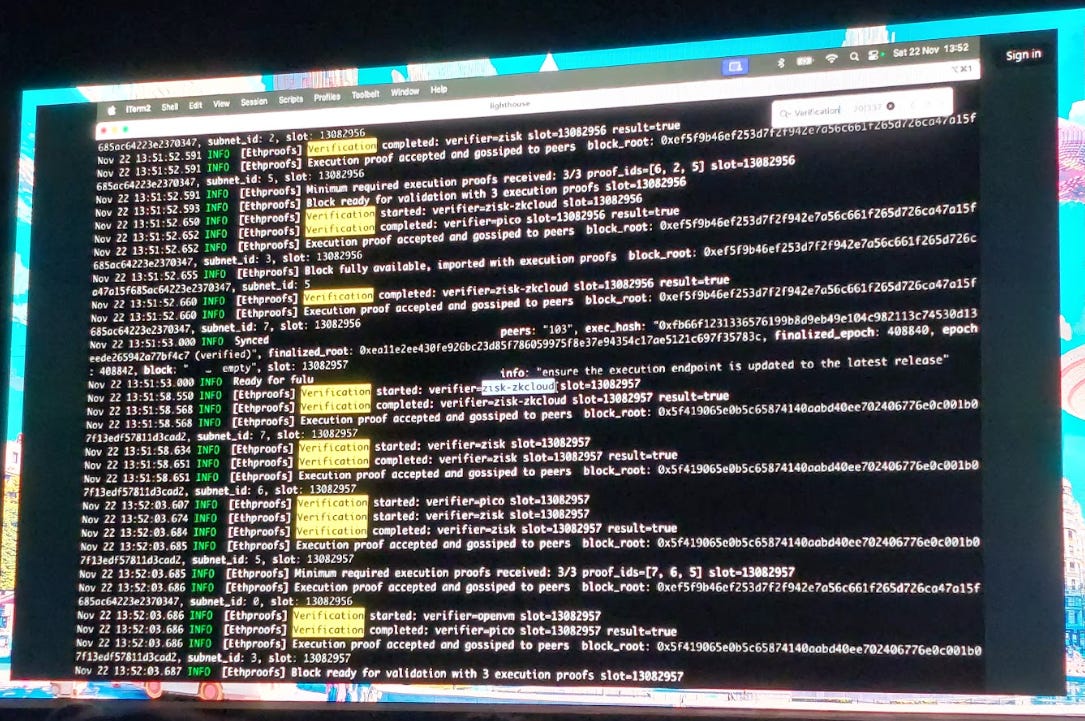
A block is considered valid if the proofs delivered are verified as valid. The screenshot below shows the verification steps performed by the beacon node. The first three proofs that landed were from ZkCloud (shown as zisk-zkcloud), ZisK, and Brevis (shown as Pico).
Minimum required execution proofs
Fetching and verifying a single proof on time was not enough: to ensure prover diversity, for this demo, a minimum of three valid execution proofs were needed for a block to be considered valid. As per the screenshot below, the first three proofs were received successfully from the clusters mentioned above.

Once a proof was accepted and verified, it was gossiped to the other participants in the peer-to-peer network. After the minimum number of proofs was reached, Justin’s validator node published the attestations successfully.

While the demo was the first experiment of its kind, its significance reaches far beyond a single event at Devconnect. It offers a concrete glimpse of Ethereum’s emerging path toward scaling the L1 and also signals the beginning of a new era where ZK infrastructure becomes an integral part of Ethereum’s core protocol.
The winner among zkVMs: ZisK
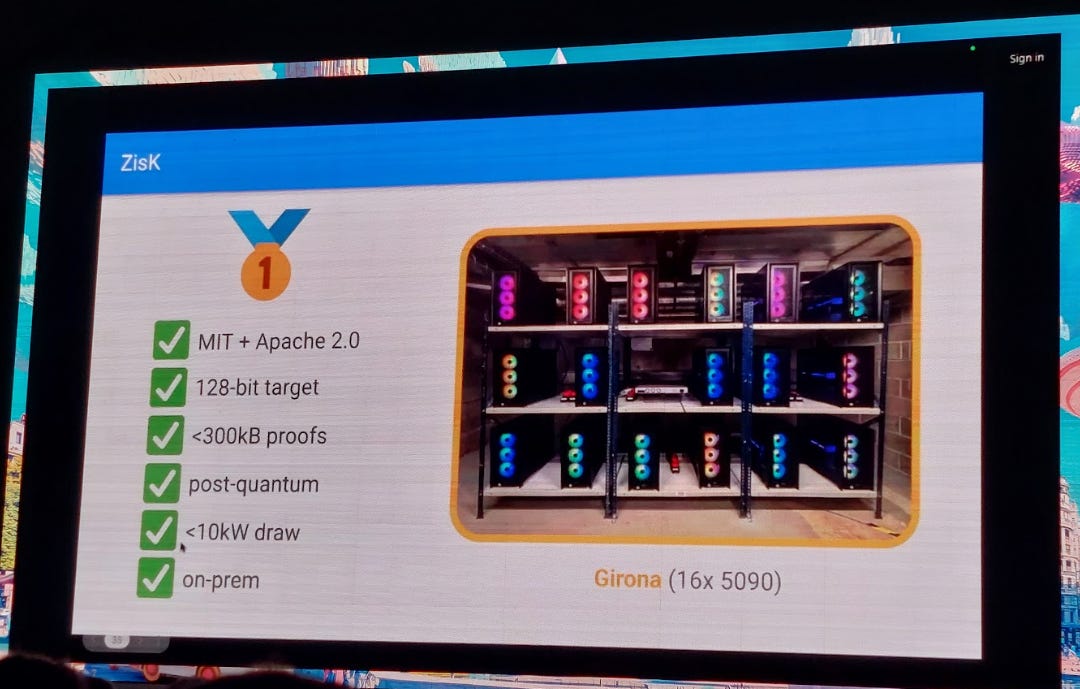
In June 2025, the Ethereum Foundation defined a set of criteria for real-time proving. The demo at the Ethproofs day was the culmination of the race towards these goals, which would have been considered impossible by most people even 6-8 months ago.
Among the zkVMs, ZisK ticked off all the criteria and came on top in the race to real-time proving. Congratulations to Jordi and the entire ZisK team for this achievement. Truly amazing!
ZkCloud’s prover setup
We did some early tests with ZisK in June 2025 and returned to their zkVM v0.12 in September. With v0.13, we already reached real-time proving on our bare metal cluster of 4090s with 48 GPUs distributed over 12 servers. However, for the demo, we used the most recent release, v0.14, which proved to be very stable.
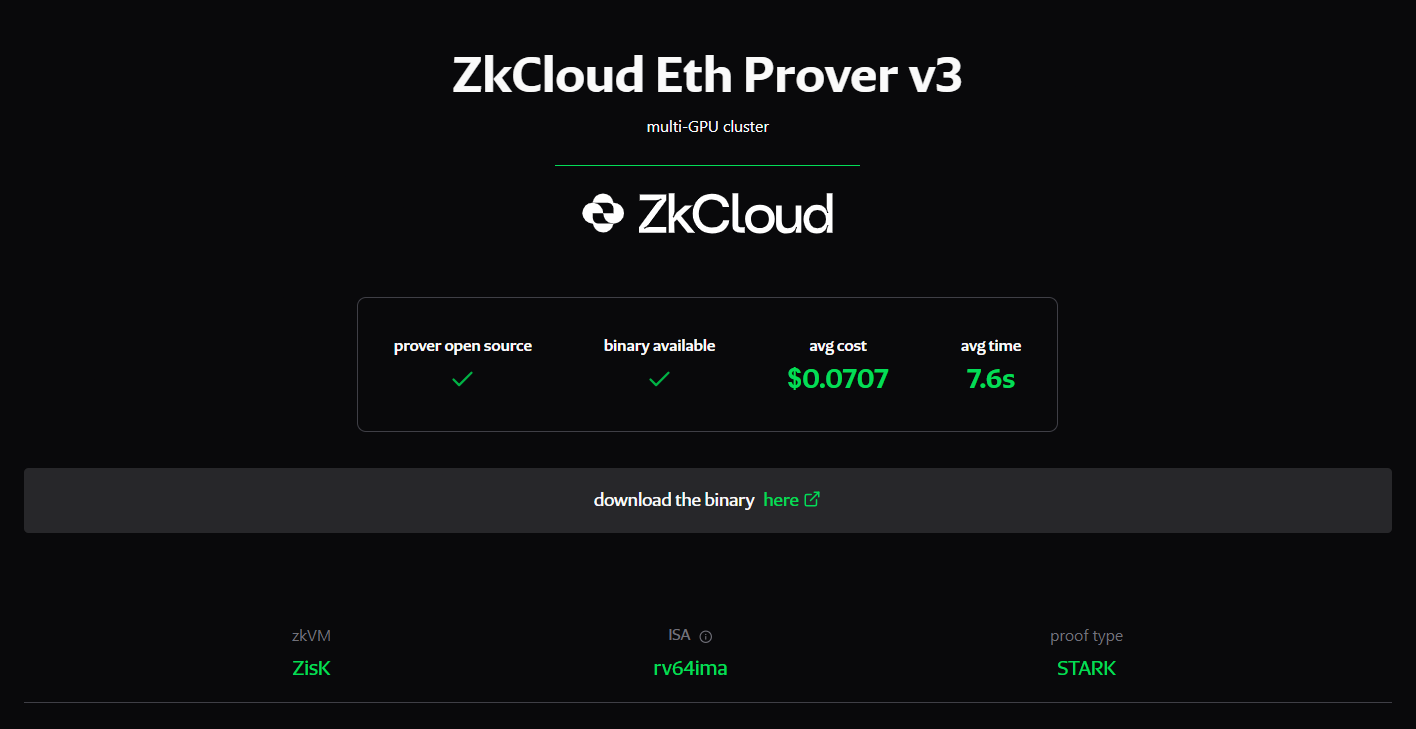
As for the Ethereum block prover, we’ve built our own custom binary as a guest program, inspired by RSP, Zeth, and Reth stateless.
With the above setup, we can prove Ethereum mainnet blocks with an average proving time of 7.6 seconds.
Closing thoughts
Although real-time proving is now a reality, it is not something that we should think of as a static achievement. The planned gas limit increases over the coming years will challenge zkVM performance and require that the execution and proving speed improvements of zkVMs outpace the growth of block space.
The game is on, but there is still a lot of work to be done. Nevertheless, with the demo at the Ethproofs Day, Ethereum has entered a new territory. To quote Justin: “This is a small step for my validator node, but a giant leap for Ethereum.”
___
About ZkCloud:
ZkCloud is the first universal proving infrastructure for ZK. Generate ZK proofs for any proof system at a fraction of the cost. Fast, cheap, and scalable.
Learn more about ZkCloud:
Website | Docs | GitHub | Blog | X (Twitter) | Galxe Campaign | Telegram | Discord